

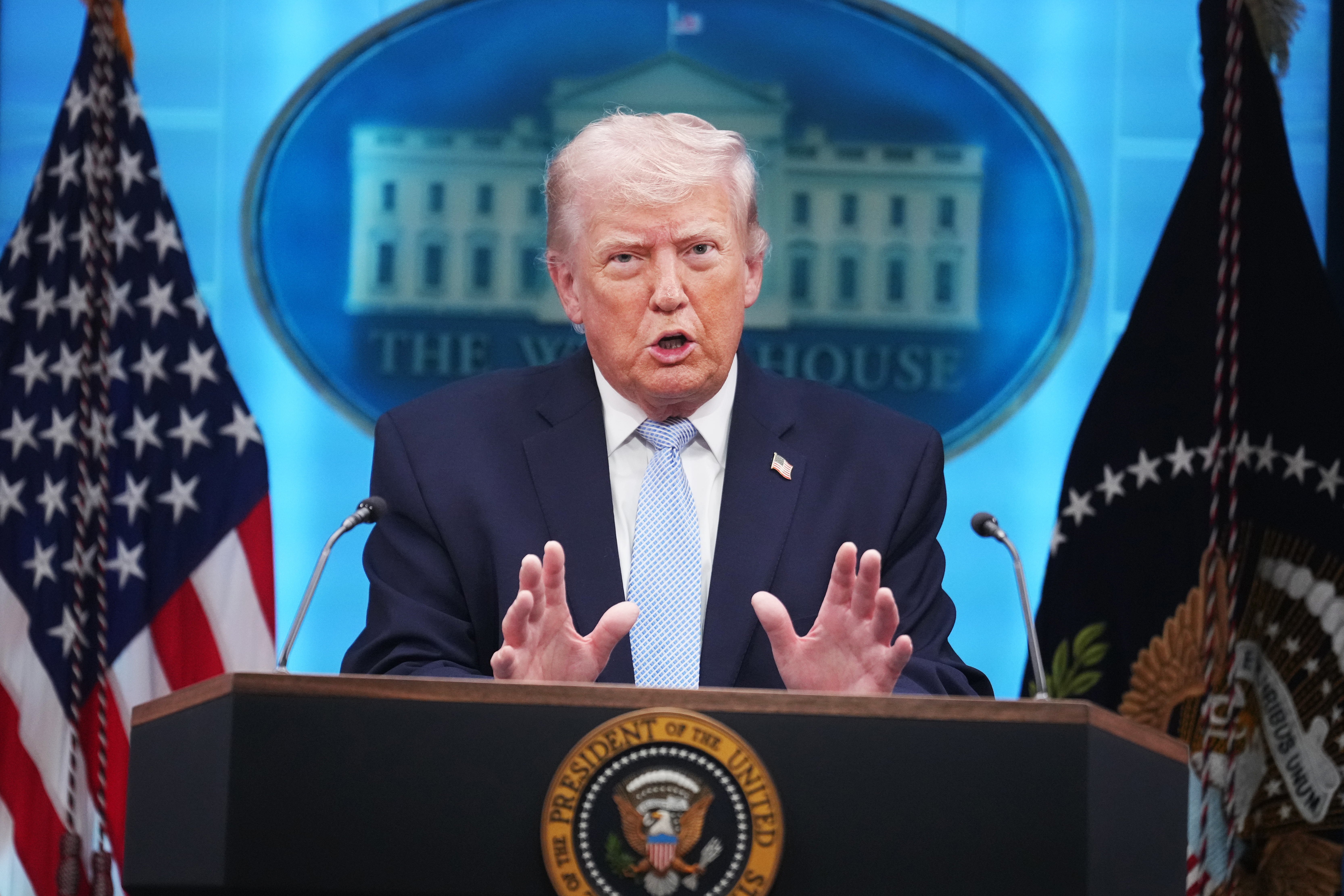
There are strings attached to President Donald Trump’s latest olive branch for Iran to avoid a resumption of war, and there are real concerns over what could come next.
Trump said the two-week-old ceasefire with Iran will continue at the request of Pakistan, but some in Chicago are fearful the administration will fulfill its promise to wipe out bridges and power plants there.
Iranian officials seems less than enthusiastic about peace prospects,even with the extended ceasefire. A U.S. Navy blockade of Iran’s oil tanker waterway the Strait of Hormuz will also continue amid the ceasefire, something Iran says it flat-out won’t accept.
If no peace plan is reached, the U.S. is expected to resume airstrikes, with Trump threatening on social media to eliminate all bridges and power plants in the country, including its one and only nuclear-fueled generation plant.
If the president does order missile launches to resume from American battleships in the Gulf region, along with bombing runs by warplanes taking aim at Iran, he has said that the next target would be those power plants.
Every plant would include the Bushehr Nuclear Power Plant, a Russian-built thousand megawatt facility. It was opened in 2013 and is located right on the Persian Gulf.
“This could be the first time that we have a nuclear incident created in a war time since the bombing of Hiroshima and Nagasaki,” said Rachel Bronson, a senior advisor at the Bulletin of the Atomic Scientists in Chicago.
Bronson has managed the famous “Doomsday Clock,” and is sounding the alarm on what she says would be a dramatic escalation in the conflict.
“Targeting a nuclear power plant just takes us to even a whole new level of what we’re talking about here. So it’s all a new world that we’re in right now,” Bronson said.
Even as the Iran pause continues for an undetermined time, what would the outcome be to that region if the U.S. did blow up a nuclear power generating plant?
“If the U.S. hit the nuclear power plant, and the fail-safes didn’t work, and we got some sort of leak, you could get a spread of nuclear material,” Bronson said. “The Iranians have said very clearly, they’ve reminded the United States, that Bushehr-the nuclear power plant-is closer to Doha and Dubai than it is to Tehran. So, our allies would be at risk, the Iranian people would be a risk, should there be a leak.”
In the nuclear blast zone along the Persian Gulf would be U.S. warships, operated by thousands of American sailors, aviators, Marine’s and other U.S. military personnel.
For Bronson, an energy and geopolitical expert also with the Chicago Council on Global affairs, the larger problem is putting civilian roads and utilities in U.S. crosshairs in the first place.
“Targeting civilian infrastructure is a game changer,” Bronson observed. “Presidents don’t threaten that. Those are byproducts, they’re accidents, they’re not targets. And so, it’s against international law, it’s against the rules-based order that the U.S. has been defending for 80 years. It’s really quite extraordinary.”
Bronson has written about a renaissance underway for atomic energy production, around the world and especially in the Middle East-facilities that for decades have been off limits to combatants.
Then the Russians began hitting nuclear sites in Ukraine and now it’s the U.S. eyeing nuclear targets in Iran…the irony Bronson says is that just as nuclear plants regain popularity, so too does the threat to having them targeted for dangerous destruction in wartime.

