

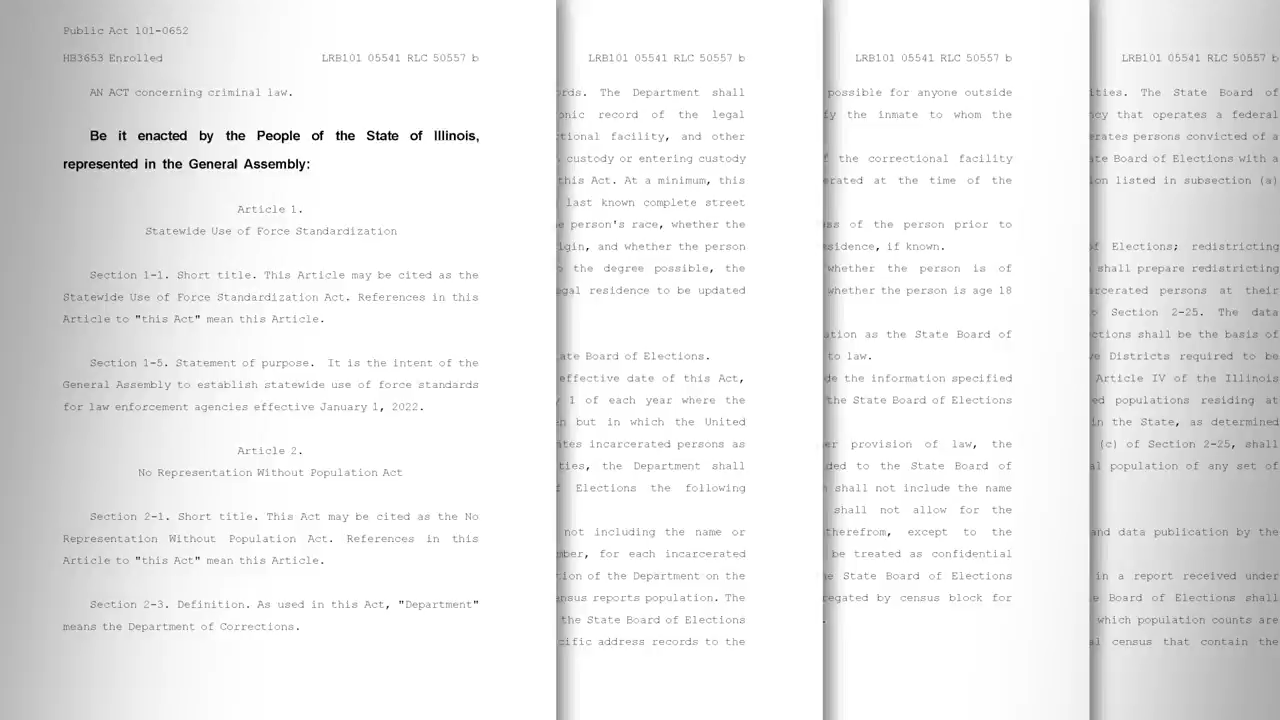
The fatal shooting of a Chicago police officer is once again reigniting conversations about the Safety, Accountability, Fairness and Equity-Today Act, commonly known as the SAFE-T Act.
So, what is it? The law made many changes to the way criminal cases are handled in Illinois.
The law got rid of cash bail. Instead, judges decide who gets locked up. The goal was to keep dangerous people detained pending their trial and not to keep someone accused of lesser offenses locked up just because they can’t afford bail.
In the case of 27-year-old Alphanso Talley, who was charged with first-degree murder and other crimes, he has a criminal record going back almost 10 years, including three separate armed robberies.
In May 2025, he was charged with armed robbery and carjacking in two separate cases. During the proceedings, a judge gave him an ankle monitor and put him on house arrest.
His release from custody during that time is being questioned by numerous officials after he allegedly fatally shot 38-year-old CPD Officer John Bartholomew and critically wounded another officer in a shooting at Endeavor Swedish Hospital on Saturday.
NBC 5 Investigates found that in January, a judge ruled Talley could go to college and didn’t have to stay home anymore. Court documents show his ankle monitor device stopped connecting in March, and he missed curfew. That same month, he missed a court date, leading to a warrant for his arrest.
In order to be locked up under the SAFE-T Act, judges must decide someone is a flight risk or a safety threat. To be held, the suspect must be charged with specific crime, including certain felonies like first-degree murder and armed robbery, sex offenses, weapons offenses, domestic violence offenses or violating an order of protection.
It’s largely up to the judge’s discretion.
On Tuesday, Cook County State’s Attorney Eileen O’Neill Burke said she did not agree with the judge’s decision to release Talley.
“We established that he had four pending violent felonies, and in spite of that, he was placed on electronic monitoring. Electronic monitoring system is broken. It does not work. It is not keeping people safe. So the State’s Attorney’s office is going to continue to ask for detention each and every time we believe someone presents a danger,” she said.
How does the SAFE-T Act work?
Illinois became the first state in the nation to eliminate cash bail with the SAFE-T Act, despite much debate among legislators and legal challenges that concluded with a ruling from the Illinois Supreme Court.
Under the bill, the state instead allows judges to determine whether individuals accused of a specific set of felonies and violent misdemeanors pose a risk to another individual, or to the community at large. Judges are also be asked to determine whether the defendant poses a flight risk if released. If the judge makes any of those determinations, then the defendant may be held in jail prior to trial.
The list of so-called “forcible felonies” that could invite judicial discretion on pretrial detention includes:
- first and second-degree murder
- predatory criminal sexual assault
- robbery
- burglary
- residential burglary
- aggravated arson
- arson
- kidnapping
- aggravated battery resulting in great bodily harm
- Hate crimes
- attempts of crimes that are detainable
- animal torture and DUI causing great bodily harm
- any other felony that involves the use or threat of physical force or violence against an individual
In 2024, O’Neill Burke announced that her office would seek detention for anyone accused of the following in Cook County:
- every detainable felony offense where an offender used or possessed a firearm equipped with an extended magazine, drum magazine, automatic switch, or used a ghost gun or defaced firearm;
- any domestic violence-related, stalking or sex offense where the offender used or possessed a weapon;
- any detainable felony offense that is committed on public transportation;
- all Murder or Class X felony offenses (e.g., First-Degree Murder, Aggravated Arson, Aggravated Battery of a Child, Aggravated Kidnapping, Aggravated Vehicular Hijacking, Armed Robbery, Home Invasion, Solicitation of Murder)
- all sex offenses where the victim was under the age of 13 and the offender was an adult throughout the duration of the offense or when the offense was committed during the commission of another felony; and
- all cases involving the manufacture, dissemination, or possession of child pornography
But each county handles the policy in its own way.
“One of the flaws or the current implementation failures we’re seeing now is a failure of the state to collect statewide data about how this law is being implemented on the ground,” Alexa Van Brunt with the Northwestern Pritzker School of Law told NBC Chicago. “The judiciary, the administrative offices of the courts, it’s supposed to be collecting data from DuPage, from all these different counties about how the law is implemented and things like return to court rates and figuring out whether there are new arrests and new offenses being committed by people out on release. And some of this data is getting collected and a lot of it’s not. And if we don’t have true transparency into how it’s being implemented, it’s really hard to answer some of those questions.”
Still Van Brunt noted there are successes.
“What we do know though is there are trends and that all the counties are showing … a lot of the counties are showing lower jail rates, lower detention rates, and crime is down throughout Illinois. We know these meta statistics, but we’re missing some of the more particular and important data points about how this law is being implemented,” Van Brunt said.
Detention hearings are not mandatory for crimes that include probation as a possible punishment, but judges can still make the determination to keep those defendants incarcerated pending trial if they determine they are a risk to the public.

