

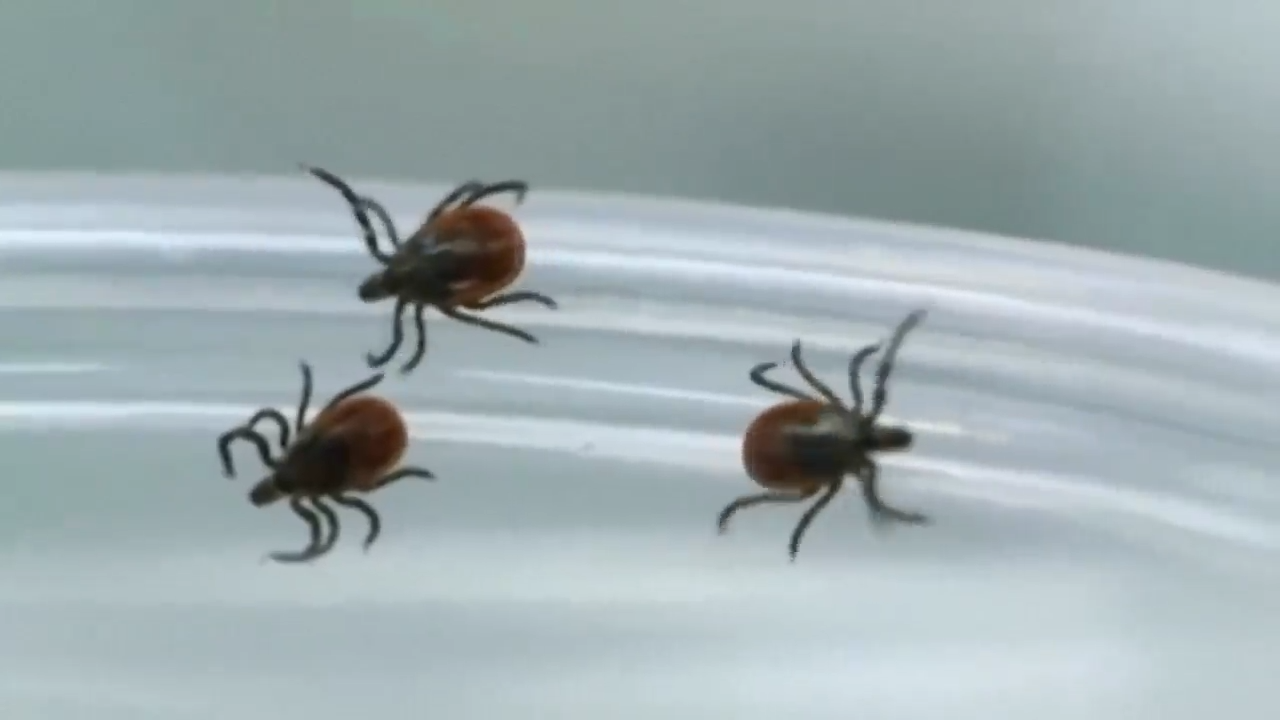
A rise in lyme disease-positive ticks and an increase in emergency room visits due to bites this spring has sparked plenty of concerns — and theories — about why such increases are happening.
While scientists argue climate change and other related factors are behind the spike, unsubstantiated social media claims are spreading rapidly.
In one case, rumors began circulating on social media indicating farmers in undisclosed locations were finding boxes of ticks on their Midwest properties. The theory appeared to originate from a social media post in which a holistic health influencer claimed she heard about such incidents “directly from farmers.”
Though she did not make a connection to the lyme disease vaccine in her post, many began to theorize the scenes could be related to one as Pfizer had recently announced the results of an ongoing trial for its latest vaccine.
The theory permeated comment sections for NBC Chicago reporting on the 2026 tick season and lyme disease infections.
But no health officials contacted by NBC Chicago had heard of such incidents taking place in Illinois and experts said it is not likely to be true.
“From a scientific perspective, I’m not sure how one would accomplish that,” Dr. Matthew Leslie, an epidemiologist with the Illinois Department of Public Health, told NBC Chicago. “Ticks have very complex life cycles that require interaction with a number of animals in a wild setting. I have no reason to place any credence in that theory.”
Similarly, Chris Stone with the Illinois Natural History Survey at the University of Illinois said ticks were already climbing in numbers.
“That seems very unlikely, and it doesn’t really make sense to me that that would be the case,” Stone said. “And unfortunately, just with the current levels of ticks that we have out in the wild and the high levels of infection with Lyme that they have – up to 40% in the adult ticks – Lyme is incredibly common already. And it’s now the most common vector borne disease in the continental United States. So yeah, maybe unfortunately they don’t need any help. They’re doing perfectly fine infecting us just like this.”
In an investigation from Snopes, Missouri officials also reported no such incidents.
While no such “boxes of ticks” have been confirmed, there are things known as “bait boxes” designed to attract “animal hosts” often linked with the spread of ticks and lyme disease, such as mice or chipmunks. Such boxes have been around for decades, but gained larger traction starting in 2012.
It’s not the first unsubstantiated rumor to surface surrounding ticks in recent months, however.
In December, lawmakers sought to have the Government Accountability Office “investigate whether the U.S. military weaponized ticks with Lyme disease.”
Meanwhile, in March, Pfizer and Valneva announced their Lyme disease vaccine showed more than 70% efficacy in a recent study. Both groups are reportedly looking for approval in 2027.
What’s actually happening right now?
The rumors come as tick season seems to be off to a fast start, with an unusually high number of bites already reported across the country. Some U.S. doctors are worried about the potential for a bad year for tick-borne diseases.
Tick populations vary throughout the year, and their numbers depend on a few factors. Climate change is widely believed to be having an effect: Ticks like warm, humid weather, and more can be seen after a mild winter. The more deer and mice available for them to feed on may also factor.
It will take months for systematic tick sampling by researchers to chart changes in tick populations. And because not every bite results in an infection, it will also take time for medical experts to know whether there’s an actual surge in Lyme disease or other illnesses.
The Centers for Disease Control and Prevention issued an early advisory to the public this month to guard against ticks. The CDC’s tracking system shows that weekly rates of ER visits for tick bites are the highest for this time of year since 2017. That’s true in all regions of the country, except the south-central United States.
Tick bites typically spike in May, but “the data are telling us now is the time to take action,” said Alison Hinckley, a CDC Lyme disease expert. “Ticks are out and people are getting bitten.”
Illnesses that can be spread from ticks
Dr. Richard Horowitz, who works with chronic Lyme disease patients and is a founding member of the International Lyme and Associated Diseases Society, said he’s concerned a surge in emergency room visits for tick bites may lead to other chronic illnesses.
“It’s very important because a tick bite, even 15 minutes on you can give you Powassan virus,” he said. “So, it’s not like wait 24 hours to 48 hours and get sick. These ticks can transmit organisms very quickly.”
Powassan virus disease is rare but increasing, according to the CDC. Initial symptoms include fever, headache, vomiting and weakness.
The disease was recently detected in two Illinois counties.
“We do keep finding new pathogens in the state,” Stone said. “That landscape of disease to be at least aware of does keep changing.”
The most recent data from IDPH shows about 40% of adult ticks in Illinois test positive for the bacteria that causes Lyme disease.
There is concern among some in the medical community that more exposure will lead to a higher possibility of infection.
What can you do to protect yourself?
Experts shared the following tick-prevention advice:
• Wear light colors, long sleeves and pants outside
• Use EPA-registered repellants and perform tick checks along the hairline, back of the neck and armpits every two to three hours
• Walk in the middle of pathways, away from brush and tall grass
“The majority of ticks don’t jump. None of them fly.” Leslie said. “Oftentimes they will position themselves on the edge of leaves, grasses, bushes, right on the edges, looking to be brushed up against by a human or animal. And they’re ready to quickly crawl onto that human or animal if they’re brushed up against.”
Leslie said if a tick attaches, remove it as soon as possible using tweezers, grasping the tick close to the skin, and pulling upwards with even pressure.
If a tick has been attached for longer than 24 hours, it can be placed in isopropyl alcohol and submitted to IDPH through a local health department for identification.
“That information can later help your provider understand if there is the possibility for any disease transmission,” Leslie said.

