

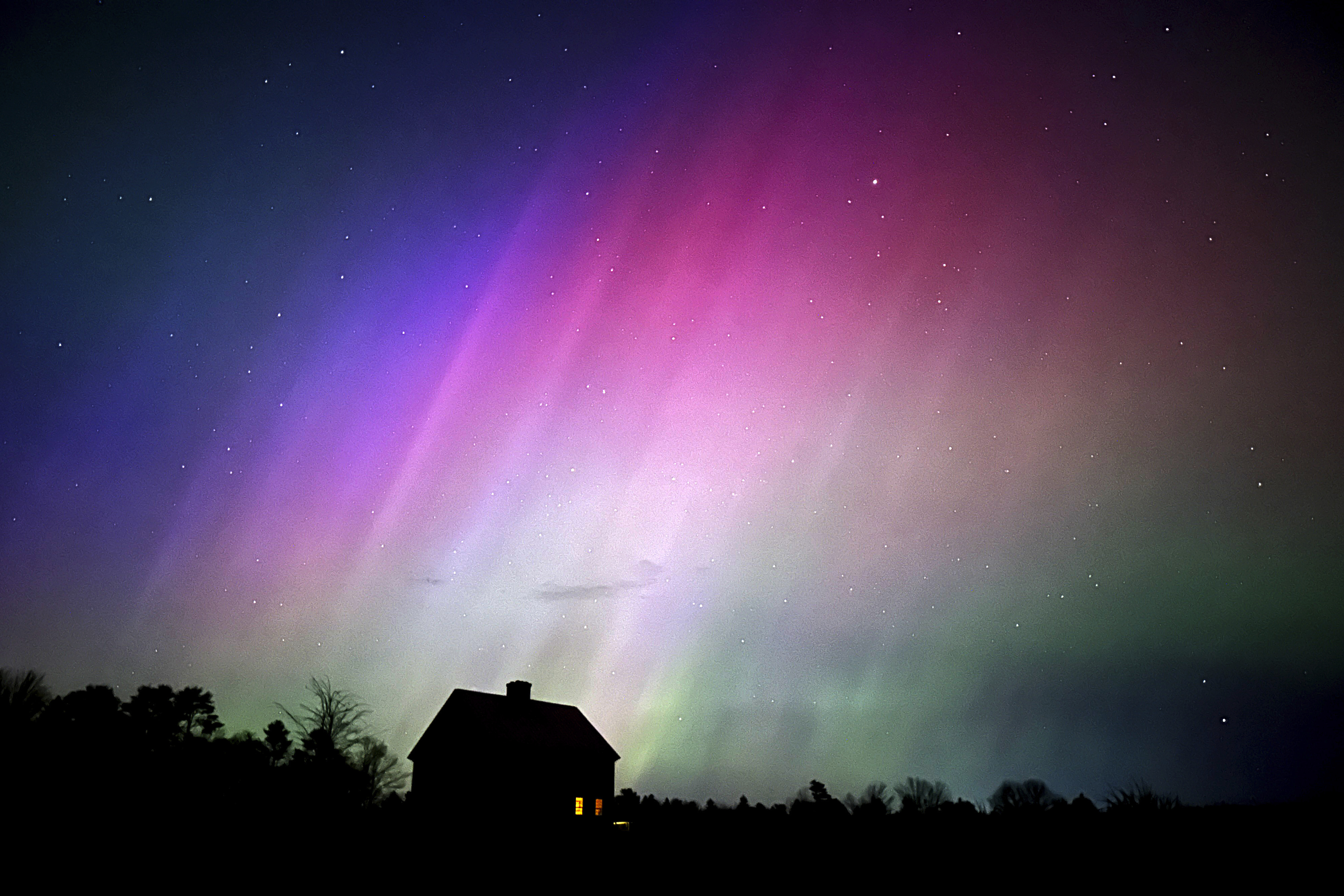
The Northern Lights could be visible as far south as Illinois Thursday night as new maps show the latest forecast update for the projected geomagnetic storm.
The Aurora forecast Thursday afternoon indicated a possible G3-level storm, which could make the Northern Lights visible in the lower Midwest.
According to the National Weather Service, the latest predictions appear to show Coronal Mass Ejections (CME’s) arriving during the mid-afternoon, with G3 levels possible in the hours following.
“CME passage would likely continue into the evening and possibly overnight hours of June 5,” the Space Weather Prediction Center wrote on social media.
CMEs are “large expulsions of plasma and magnetic field from the Sun’s corona,” NOAA reported. “They can eject billions of tons of coronal material and carry an embedded magnetic field (frozen in flux) that is stronger than the background solar wind interplanetary magnetic field (IMF) strength.”
The Space Weather Prediction Center called it a “rather complex series of events and circumstances,” which makes predicting the Aurora forecast challenging. While there is a “fair level of confidence” they’ll arrive on Earth, it’s not quite clear just how intense they’ll be.
The National Weather Service also said there is a possibility of a “combination event,” which would raise the potential for the Northern Lights to be visible in the Midwest.
That show could be coupled with clear skies, which could again raise the possibility of the lights being visible.
The auroras occur when energized particles collide with Earth’s atmosphere, causing colorful glows that can appear in a variety of shades and hues.
The best way to see the Northern Lights is to find a space with a clear view of the northern sky, and to allow your eyes to adjust for at least 15 minutes to the darkness.
Cameras can also pick up the Northern Lights more easily than human eyes can, with their lengthened exposure helping to sharpen those images.
You can stay tuned to the NBC 5 Storm Team for the latest forecasts on the Aurora Borealis.

