

While forecast had been warning of a tornado threat across parts of the Chicago area Thursday, hours before the storm window arrived, things shifted.
The National Weather Service upgraded the threat level for nearly the entire area to a “moderate” risk, a level four out of five.
But it also changed the areas under the greatest threat for tornadoes and other severe hazards.
The NWS had earlier reported the areas at a greatest risk for tornadoes would be suburbs north, northwest and west of Chicago, but the path shifted as the storms approached.
“The threat has shifted a bit farther south than previously forecast and now includes much of northern IL,” the NWS wrote on X.
Here’s a map of the threat:
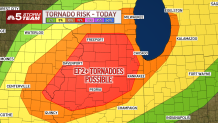
The percentages are based on the chance of a tornado occurring within 25 miles of any given point in the associated polygon.
In the Chicago area, the highest threat level is around 15%. The percentages are based on the chance of a tornado occurring within 25 miles of any given point in the associated polygon, NBC 5 Storm Team Meteorologist Kevin Jeanes noted,
The main question still lingering as storm warnings began in the region was where a boundary line would set up, based on what happens as the first waves moves through.
A tornado watch has been issued for nearly the entire Chicago area until 9 p.m.
The biggest threat for tornadoes sits in the second round of storms.
“The second one is the one I’m most concerned about,” NBC 5 Storm Team Meteorologist Alicia Roman said.
That wave is expected to begin around 4 p.m.
The window for the peak tornado threat is expected to continue until 8 p.m. And any that do develop could be strong.
“Maybe EF-1 or 2 or greater,” Roman said.
The NWS urged residents to “take tornado warnings seriously” and have multiple ways of getting alerts. (Download the NBC Chicago app for live updates throughout the evening)
The storms will still spread across much of the Chicago area through the evening, with widespread coverage by 7 p.m.
Wind gusts in excess of 60 mph are possible once again, one day after gusts tore through the region, leaving thousands without power, uprooting trees and damaging homes and buildings.
The quick-moving system is expected to begin moving out of the region around 10 p.m.
And once they do, they’ll be followed by a cold front that will send temperatures into the 60s overnight.

