

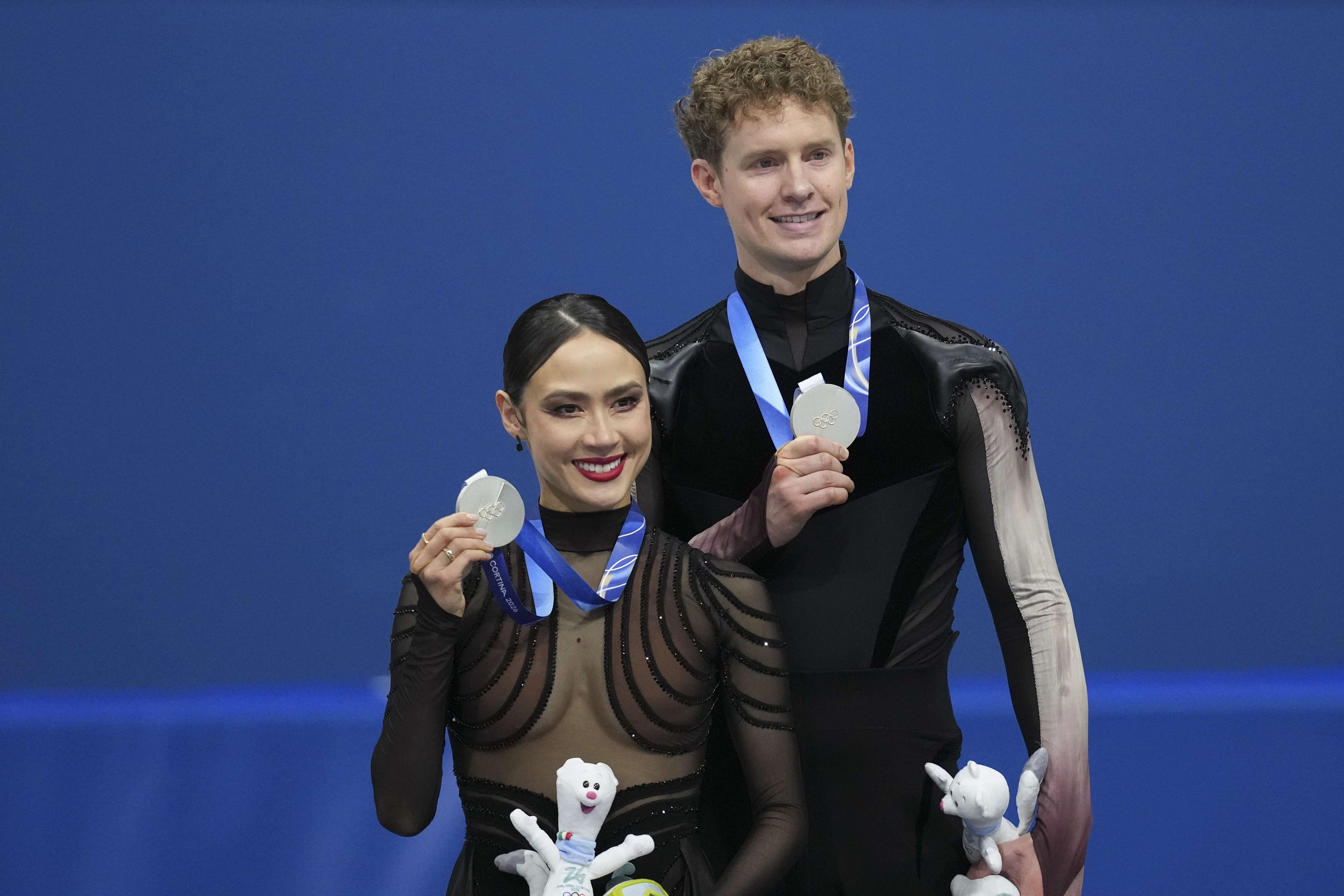
Figure skating’s first individual event at the Milan Cortina Winter Olympics ended with a shocking medal upset, and now, a questionable score from one of the judges has left the event’s final performance in question.
While the husband and wife duo of Madison Chock and Evan Bates skated a season best performance in the ice dance free skate Wednesday, the unexpected gold medal win from France’s Laurence Fournier Beaudry and Guillaume Cizeron has raised concerns from many.
Here’s a look at the controversy surrounding the skate:
The performances
Cizeron made several mistakes, including a glaring one during his twizzle sequence, while Chock and Bates were nearly perfect.
The two-time Olympic gold medalists in the team event — performing to an instrumental version of “Paint it Black” from the dystopian sci-fi show “Westworld” — turned in the kind of program they have spent the last 15 years together working toward. Every movement seemed to be in perfect harmony, and the flamenco-styled choreography had the crowd clapping along with them.
Tears formed in Bates’ eyes as the pair breathed a sigh of relief.
Chock and Bates finished with 224.39, a season best and at least a silver medal.
Then came the new French ice dance team of Beaudry and Cizeron, who have only been skating together for several months and are also facing more controversy off the ice, were the only thing standing in their way.
It looked as if Beaudry and Cizeron gave them an opening with a bobble on their twizzles.
But they soon settled into their program, set to the soundtrack from “The Whale,” and moved as if they were under water with a marvelous degree of refined elegance.
Beaudry and Cizeron answered with a season best of their own Wednesday night, giving them 225.82 points and the top step of the podium.
The scoring controversy
Despite the error in their performance, a French judge favored the French skaters by nearly eight points in the free dance, while five of the nine judges favored the American team. The other three that gave top marks to Beaudry and Cizeron did so by a slim margin.
But Judge Jezabel Dabouis’ margin was so large that if her score was removed from the equation entirely, Chock and Bates would have won gold.
Though they still won a silver medal, Chock and Bates were left in tears as their long-sought individual gold remained just out of reach.
This is not the first time Dabouis has turned in questionable scores for Beaudry and Cizeron. At the Grand Prix Final in December, when Chock and Bates beat them in their only other head-to-head matchup, the judge had the Americans narrowly beating them in the free dance despite two deductions, including an egregious fall. The French team wound up with a silver medal.
Dabouis also had a wide margin favoring the French couple in the Olympic rhythm dance, when they also beat the U.S. team.
Olympian Mariah Bell reacts to the ice dance final at the 2026 Milan Cortina Olympics, where Team USA’s Madison Chock and Evan Bates secured the silver medal.
What Chock and Bates said
A visibly emotional Chock and Bates broke down in tears following the medal results, calling their silver medal finish “bittersweet.”
When asked about their scores specifically, the duo appeared to have some thoughts.
“We really felt that we had four gold medal performances and that’s what we’re going to take away,” Bates, a Michigan native, said.
“Any time the public is confused by results, it does a disservice to our sport,” said Chock. “I think it’s hard to retain fans when it’s difficult to understand what is happening on the ice.
“People need to understand what they’re cheering for and be able to feel confident in the sport that they’re supporting.”
Fellow Olympian Mariah Bell noted the subjectiveness of the sport.
“Ice dance is truly like ballroom on ice. They are perfect all the time. There’s never a hand out of place, a foot out of place, and so that’s what makes this discipline so hard. There is absolutely no room for error and neither team made any of those big errors,” Olympian Mariah Bell said. “So I think when you’re looking at the judging of it, some people are not gonna understand it.”
Bates said they hadn’t studied the scores.
“We did speak to our coach, and we did talk to each other, and we know how we felt on center ice after we skated,” he said. “We felt like we delivered our absolute best performance that we could have. It was our Olympic moment. It felt like a winning skate to us and that’s what we’re going to hold on to.”
Bates said fan support was “incredible,” and he noted an online petition calling on the International Skating Union and the International Olympic Committee to investigate the scoring.
“We haven’t actually seen it, we’ve just heard about it, but it means a lot that people are voicing their opinions on our behalf,” Bates said. “I think the way that we skated and the way we’ve approached chasing these goals hopefully has resonated with people at home, and even in our response I think hopefully that too can reflect the Olympic spirit.”
The French and American teams are intimately familiar with each other because they have the same coaches — Marie-France Dubreuil, Patrice Lauzon and Romain Haguenauer — and train at the renowned Ice Academy of Montreal.
What the International Skating Union said
The International Skating Union later said it stands by the judging of ice dance.
“It is normal for there to be a range of scores given by different judge in any panel and a number of mechanism are used to mitigate these variations,” the ISU said, adding it has “full confidence in the scores given and remains completely committed to fairness.”
There is little recourse for the U.S. team if the global governing body is unwilling to investigate the scoring discrepancy.
The most famous judging controversy in Olympic figure skating also involved a French judge.
During the 2002 Salt Lake Games, Elena Berezhnaya and Anton Sikharulidze of Russia won gold over the Canadian pair Jamie Sale and David Pelletier. But allegations of vote-swapping and selling of votes by French judge Marie-Reine Le Gougne led to an investigation by the ISU and the International Olympic Committee, and she was ultimately found guilty of misconduct and suspended.
Sale and Pelletier ultimately were elevated to gold while the Russian pair was allowed to keep their medals.
Two years later, the ISU eliminated its 6.0 judging system due to its inherent subjectivity. The replacement system, which has been tweaked over the years but remains in place, features two scores added together: one where each element is graded off a base value to establish a technical score and another where judges provide a component score for overall skating skill and performance.
Many critics have called the system overly confusing and still too subjective.

